An
old man like me, near dotage stage cannot do anything except to show my
solidarity with the Kachin brethren, as the small Vancouver Ethnic
Community launch a fund drive for the Kachin Women Association Thailand
(KAWT) to relieve the Kachin refugees who in no-man’s land number over
100,000, and whose humanitarian aid is cut off both by the Chinese and
the Burmese governments. The clearly depicts not only the Myanmar and
the Chinese mentality, but also to what length can the dictatorial
regimes go to justify their political appetite.
Genocide in Kachin State
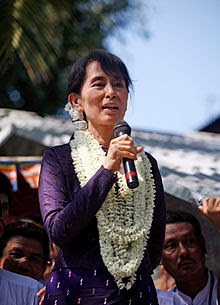
Aung San Suu Kyi
Hundreds
of people have lost their lives, thousands have been maimed or injured,
and thousands of ethnic women have been raped by the Tamadaw soldiers.
But after 1,800 battles, the conflict between Kachin freedom fighters
and the Burmese army—now into its 15th month—shows no sign of abating.
A
secret visit by a reporter mailed to me some grotesque pictures of dead
Burmese and Kachin soldiers piled on top of the corpses of civilian
porters. Farmers and villagers are now being targeted for attacks and
interrogation by the government troops who naturally suspect them of
being sympathizers or members of the Kachin Independence Organization
(KIO).1
The Burmese Army, or Tatmadaw, is determined to knock out
the Kachin, once and for all, as men and munitions are increased around
in the conflict zones. One could recall that at the recent ASEAN
Conference in Bali, President Thein Sein boasted that it would only take
a few hours for the Tatmadaw to wipe out the Kachin, and the government
media calls the Kachin as Thaung Gyan Thu, in Burmese which is usually
translated as “insurgents,” a rebel group with no political agenda and
has connotations of terrorism.2 With this kind of attitude how can there
be ceasefire not to mentioned peace negotiations? 3
The 1994
ceasefire agreement never produced a political result leading to
autonomy or fundamental rights and instead Kachin leaders were offered
business opportunities in logging, jade mining and other enterprises
viewed by the Kachin populace as a rape of the land and an attempt by
the Myanmar authorities to exploit the Kachin’s rich forests and natural
resources. Experiencing an 18-year truce shattered, no ethnic
nationalities trust the words of Naypyidaw and now every intelligent
ethnic sense that Tatmadaw is not interested in whatever peace deals.
What more prove is wanted when it is already over a year that President
Thein Sein ordered the army to stop the offensive with no result,
raising the question of whether the Burmese government is controlling
the army or vice versa.
The major Myanmar community did not
comprehend that the civil war was born out of broken promises of 1947
Panglong Conference where the Shan Chin and Kachin, nationalities agreed
terms with the central government for self-determination, autonomy and
even the future of possibility of a separate state. 4 This was ink by
non-other than our beloved Aung San the architect of modern Burma and
father of Daw Aung San Suu Kyi which became moot after Aung San was
assassinated by the ploy of Ne Win.
Since June 2011, the Burma
Army has commenced its major ethnic cleansing not only targeting the
Kachin resistance forces but the entire Kachin natives. The worst action
done by the Burmese soldiers is inhuman revenge against ordinary Kachin
villagers because they suffered severe fatalities. In fact, the
Tatmadaw repeatedly breach principles of Geneva Conventions of 1949
where, civilians must be protected by warring parties in any case and
must not be discriminated against because of race, religion or political
opinion. Geneva Conventions also not allows forcing them to give
information. Civilian must not be used to shield military operations or
make an area immune from military operations. Civilian must not be
punished for an offence he or she has not personally committed. Women
must not be indecently assaulted, raped, or forced into prostitution.
But, the Thein Sein government and the Tatmadaw turn a deaf ear to all
these. As a result, Burma Army’s full-scale offensives are becoming more
intense than ever. It seems that Thein Sein, this year nominated Nobel
Peace Prize5 is not sincere to uncover the truth and has not the courage
to accept the truth and is trying to hide the human rights violations
of his army from public scrutiny.6. A dishonor, not only for the
government but also for the whole nation, that he refused to say that
Tatmadaw has violated a variety of human rights in various ethnic
areas.7
Position of Strength
Gone with the wind, is his
utterance that there is a need for development in the ethnic regions and
that his government intended to reach out to ethnic groups for peace
talks and that the ethnic nationalities struggle is one of dimensional
and deeply-rooted in the military’s arrogant view of ethnic
nationalities and their issues.8 If he is serious about building trust
with the ethnic armed groups, he could have pressure the military to
halt its offensives and call for a nationwide cessation of hostilities,
during which preliminary talks can take place at the regional level to
understand and resolve local issues.
The world should know that
even if the Burmese army and air force could eventually defeat the
vastly outmanned and outgunned Kachin Independence Army, it would never
crush the heart and soul of the Kachin resistance or that of the ethnic
nationalities. Now the Tatmadaw has set the target that only after the
Kachin headquarters Laiza was captured then it will consider a
cease-fire and will negotiate from the position of strength. This
“dictum of peace through strength,” theory was evident as the Tatmadaw
seems to be sore afraid of the WA whose fire power and fighting ability
surpassed them and they were being forced to provide the WA states a
real federal status. If this is their hidden logic than every ethnic
nationality of Burma must take a page out of the WA example and builds
up a formidable defense force to protect themselves from the marauding
Tatmadaw. So Thein Sein theory of only one army for the country holds no
water at all.. In the meantime this ruthless military operation will go
on with a tactic approval of Daw Aung San Suu Kyi who says nothing on
this matter even though she has fight for democracy and human rights all
her life.
Instead the Thein Sein administration in using divide
and rule tactics e.g., he could wean out the Buddhist (DKBA) from KNU
and is now giving bait to the more economically inclined group of three
musketeers ( Mu Tu Say Po, Roger and David Taw)9 . In Karenni it was
able to lure the KNPLF (Karenni People’s Liberation Front) to be under
the BGF (Border Guard Force) from the more enlightened KNPP (Karenni
Nationals Progressive Party).So also in Shan, Mon, Arkanese was able to
force the smaller but more economically inclined groups, in other words
small war lords to enlist with the BGF, forcing them to split from their
mother unit. By looking at these episodes one can question not only the
sincerity of the Thein Sein administration but the Mahar Myanmar
mentality, the policy of a great nation forcing all the ethnic
nationalities to be under one religion (Buddhist), one race (Myanmar)
and one country.
Under this scenario it was incredible that
Western countries that emphasize so much on democracy and human rights,
embodied in the universal declaration of human rights has taken off
almost all their punitive actions only because the quasi military regime
has successfully used Daw Aung San Suu Kyi to be their spokesperson.
Will the fate of 30 million plus ethnic nationalities (a population much
larger than Canada) be abandoned by the Free World countries, the moral
champion of the world, only because she can charm the world leaders and
let the suffering Burmese ethnic communities under the boots of Mahar
Myanmar Colonialism? America still remains the indispensible nation but
not omnipotent.
NLD minus Daw Suu Kyi is equal to Zero
One
of the commanders in negotiating with the unarmed Burmese group in
Thai-Burma border area frankly remarked that NLD without Daw Suu Kyi is
nothing. In fact he admitted that they are worst than the cronies of the
Junta. It must be recalled that when Daw Aung San Suu Kyi, was just
freed from house arrest she offered words of reconciliation she said,
“It is impossible to achieve development without peace in our country.
The suffering of Kachin people is the suffering of Myanmar people and we
all have to find a cure for these problems.”10 But today she is silent,
perhaps in changing from democracy and human rights icon to politician
she has learnt that Silent is Golden in view of that fact that now she
is aiming for the post of President in a fragile new quasi-democracy. At
a talk in London in June, a student from the Kachin ethnic minority
asked why she belonging to the majority Myanmar is reluctant to condemn a
bloody military offensive she could not answer.
Neither could she
answer to the plight of the Arakanese Muslims. How can a woman, the
world has watched fight for her people against the might of a military
junta for decades, not have a word to say when an entire part of her
country’s population is being violently attacked?11 Obviously ethnic
groups accuse her of condoning human-rights abuses by failing to speak
out on behalf of long-suffering peoples of Burma. A woman so widely
revered should arouse such hostility might have seemed unthinkable.12
Once idolized without question for her courageous two-decades stand
against the tyranny now faces a chorus of criticism even as she emerges
as a powerful lawmaker here.
Previously to criticize her is
considered as a betrayal of the cause that so many Burmese had embraced
and dedicated their lives to it, not that Daw Suu Kyi was perfect; but
to point out her flaws was to give comfort to the hated regime which
ruled Burma with an iron fist.13 But that days are over, and many a
people noted that her stance on the burning ethnic issues left a great
deal to be desired. As a Nobel Peace Prize winner and an international
icon for democracy and human rights, many expected her to be more
outspoken about the ongoing war in Kachin State and even more
contentious issue of the status of Arakanese Muslims. This clearly
points out the true colour of realpolitik. For the Nobel Peace Prize
laureate and democracy icon, it is personal. Will she be her father’s
daughter and carried on the family tradition to preserve the Union of
Burma where autonomy of the ethnic nationalities to be equated with
national building and worked for the Second Panglong Conference or will
she side with the Junta’s Mahar Myanmar policy to treat the ethnic
nationalities as colonial people or second citizen is still to be seen?
Her
moral clarity helped make the former junta a global pariah. Her new
role as political party leader demands strategic ambiguity as well. She
must retain her appeal to the majority Myanmar, without alienating the
non Myanmar ethnic nationalities and compatriots of other faiths. At the
same time she must also engage with the widely despised military, which
remains by far the most dominant power in Burma. A saint-like
reputation for unwavering principle can be unhelpful in politics, a
murky world of compromise and negotiation. So can adulation, which
generates expectations that not even Burma’s “human rights superstar”
can fulfill. “To be criticized and attacked is an occupational hazard
for politicians. To be praised and idealized is also an occupational
hazard and much the less desirable of the two.” She wrote it 14 years
ago.
The legendary former political prisoner, and perhaps one of
the most famous hostages of the millennium. Could anything be more
politically dramatic than witnessing the woman take the place of the
very regime that placed her under arrest, separated her from her family,
and banned her from taking office even after winning landslide
elections? Daw Suu Kyi is arguably one of the most romanticized
political figures of modern times.14
But at the same time she is
also adapting to life in Naypyidaw, where men in green uniforms,
dominate one side of the chamber, chosen by armed forces chief Gen. Min
Aung Hlaing, a protégé of the retired dictator, and she has finally
agreed to uphold Burma’s constitution, ratified after a fraudulent
referendum in 2008 does not paint a rosy picture for the ethno
democratic groups. But it has to be admitted that her mere presence in
parliament breathes legitimacy into a political system built by the
Junta and now hypocritically encourage by the West vis a vis China.
NLD’s
refusal in April to swear a parliamentary oath to “uphold and abide by”
the constitution is one of the testing point. After a two-week
stand-off and criticism from supporters, the “Iron Aunty” backed down
and her MPs took their seats. Why? There are several justifications, but
it indicates that her party has few real policies beyond the statements
of its world-famous chairperson. This led to the question of who are
her compatriots? Is it a club of Daw Suu Kyi’s loyalists that fails to
reach out to other influential groups in Burmese society? Why is there
not one to point out the loop whole?15 Many returning exiles and
intellectuals have been kept at arm’s length from Suu Kyi and it is
jealously guarded by those closest to her.16 Why are the Burmese
intellectuals ignored? Until and unless she her own house in order and
provide genuine leadership within her own party she cannot lead the
country.17 Daw Suu Kyi needs to recruit young, intelligent and daring
Burmese intellectuals abroad to come and work for the country.18 In this
respect she should take a leave out of Than Shwe who did a better job
of choosing suitable subordinates to support his long-term goals.
Besides she has given no hint of who her political successor will be,
and no one in her party stands out as a likely candidate even though she
will be 70 in 2015.19
It also makes us ponder, what kind of
leader Daw Suu Kyi will be, and exactly how different will her
government be from the military rule that preceded it?20 The NLD’s
parliamentary debut has also highlighted a lack of concrete policies and
experts to formulate them, a critical weakness when Burma’s reformist
government is drafting new legislation at a breakneck pace?
Daw Suu
Kyi’s popularity in Burma is not as universal as many Western admirers
assume. She is adored in the lowlands, where fellow ethnic Myanmar
predominates and her image adorns homes, shops, cars and T-shirts. That
reverence fades in rugged border regions, occupied by ethnic
nationalities who have fought decades-long wars against Myanmar’s
-dominated military. In rural ethnic dominated area especially in Shan
State the images of Daw Suu Kyi are hard to find. Khun Htun Oo, a
leading Shan politician who was jailed for almost seven years simply
said that Suu Kyi has been “neutralized” by participating in parliament.
Worst of all in an interview with Amanpor of CNN she admitted her “soft
spot” with the marauding Tatmadaw without realising that the Burmese
army has change from patriotic army to pocket army of the generals that
has dragged the country to the bottomless pit during all this half a
century. For years, the NLD backed calls for a United Nations Commission
of Inquiry into alleged war crimes and crimes against humanity in Burma
has been push back or been quietly dropped since her release. “What we
believe in is not retributive justice but restorative justice,” she said
in, if that is the logic than it is useless to tackle corruption and
human rights in Burma.
No doubt she has quickly become an
influential voice in the country’s newly empowered parliament.
Economists worry that her bleak public appraisals of Burma’s business
climate will scare foreign investors. No doubt, one way or the other,
Daw Suu Kyi’s place in Burmese history is assured. But if she wants to
leave a legacy of lasting stability, and not just an image of heroic
self-sacrifice as a guide to future generations, she’s going to have to
have to start tackling the problems of her country—and her party—head
on.
We sense that her strategic sense compels her to utter
compromising attitude, ambiguous responses, silence on some critical
issues and her soft corner for the military to gain the trust of the
Generals as she is fully aware of the central political role of the army
and hence is seeking its cooperation in furtherance of her goals,
particularly in amending the Constitution.21 She knew that the army
cannot be wished away and would not listen to thoughtless critics. Any
way she needs them and any dilution of Army role can only be
evolutionary, as we see it in other countries similarly situated. But
she is very soft in pedalling on ethnic issues for fear of upsetting the
administration in its peace moves, even at the risk of becoming
unpopular with the ethnic groups. We also knew that the success of
President Thein Sein in his political and economic reforms is key to the
country’s transition to democracy and hence she is bound to support his
moves. The urgent need is “capacity building” within her party and the
country. She is in a better position than others to look outside the
country for support. The period from now till 2015 is crucial and hence
Suu Kyi has to play her cards to the best advantage of herself, the
party and the country and still needs the support of the majority of the
people to cross many hurdles.
There is little doubt that Suu Kyi
still enjoys enormous support among Burma’s people, despite questions
among some about her commitment to the country’s ethnic nationalities.
However, looking beyond the next few years, she needs to think not just
about her own role in Burma’s future politics, but also that of a
younger generation of would-be leaders. There is still time and Daw Suu
Kyi knows that she could not cross the lines which her father has drawn
and that still the hopes and aspirations of ethnic nationalities are not
lost yet. She is the only Myanmar which the Non Myanmar ethnic
nationalities trust, to lead the country to the Genuine Union of Burma
which her father had envisaged, where love, peace equality and democracy
reigns. We clearly have idolized her to the point of no return. We want
to believe that the fight she waged for a ‘free’ Burma includes the
ethnic nationalities as well. There is no single figure who could draw
the attention and create a solution to the crisis the way Daw Suu Kyi
can. The ethnic nationalities and the world have waited for decades to
see Burma’s “Lady” descend upon what we all believed was her rightful
political throne, with a hope that Myanmar spring will not be a
Non-Myanmar ethnic nationalities long winter.
Prof. Kanbawza Win can be directly contacted by email at bathannwin@gmail.com
Notes: 1. Yan Naing, Saw; The Forgotten War in Iirrawaddy 18-7-2012
2. Zaw, Aung: Ending the Vicious Circle—Making Peace in Burma Irrawaddy 28-11-2011
3. The government offered Nayoyidaw, the counterpart of Laiza to be the
venue of talk for cease-fire for the KIO to kow tow the government but
later agree to the border town of Ruili or Muse
4. Yan Naing, Saw; The Forgotten War in Iirrawaddy 18-7-2012
5. The greatest joke is that Thein Sein, who was a Prime Minister that
had exterminated the Buddhist monks in the Saffron Revolution of 2007
and later prevent the international humanitarian aid reaching to the
Nargis storm ravage victims in May 2008 resulting in 140,000 people dead
and left 2.4 million homeless was among the nominee for the Nobel Peace
Prize. Praise the Lord that it is awarded to the European Union.
6. Lin, Zin; Is President of Burma worth of Nobel Peace Prize, Eurasia Review, 8-10-2012
7. Linn, Zin; A Kachin War disgraced to the President Eurasia Review 6-10-2012
8. Lin, Zin; Is President of Burma worth of Nobel Peace Prize, Eurasia Review 8-10-2012
9. I personally knew him and his wife since he was active in the Rangoon University Karen Students Association
10. Gray, Denis; As Myanmar thaws, decades-old civil war festers on AP 4-02-2012
11. Hossain, Anushay;The silence of a laureate: ethnic & religious tensions rise in Burma Forbes 8-10-2012
12. Marshall Andre RC FMT News 6-10-2012, Also in Jakarta Globe 7-10-2012
13. Zaw, Aung; Can Suu Kyi Lead in Irrawaddy 10-10-2012
14. Hossain,Anushay; The silence of a laureate: ethnic & religious tensions rise in Burma Forbes 8-10-2012
15. When I was Prime Minister’s of Foreign Affairs, the then Prime
Minister of Pakistan Ali Bhutto in going to China flew over Burma and a
telex machine crack besides me “Greetings from the Prime Minister of
Pakistan to the Prime Minister of Burma.”. There was a cabinet meeting
and I have only 7 minutes to reply. So I telex back Bon Voyage from the
Prime Minister of Burma. It was only in the evening when I have a chance
to meet him that I told him the story. As a responsible person I have
the courage to do it. The point which I am pointing out that Daw Suu Kyi
should be surrounded by such persons.
16. Zaw, Aung; Can Suu Kyi Lead in Irrawaddy 10-10-2012
17. During her visit to US my friend Kyaw Thi Ha goes personally with
his own expense from Vancouver to Fort Wayne and I handed over a short
letter to be deliver to her but her PA Dr Daw Nge took it and was never
handed to her.
18. I could not comprehend why young and energetic
Burmese intelligentsia like Zin Lin, Min Zin, Zar Ni, Aung Htoo and the
likes are not recruited.
19. Zaw, Aung; Can Suu Kyi Lead in Irrawaddy 10-10-2012
20. Hossain,Anushay; The silence of a laureate: ethnic & religious tensions rise in Burma Forbes 8-10-2012
21. Kuppuswamy c s SSAG, Euro Asia 11-10-2012


As a matter of fact, Suu Kyi is half-Karen. Her mother Daw Khin Kyi was a Catholic from a Rangoon delta town. In the past, leaders from different ethnic background served the nation – for good or ill – including Sino-Burmans General Ne Win and Brigadier Aung Gyi .
Dr Ba Maw, prime minister during British Rule, was a Mon. So was Colonel Sein Lwin, branded the *Butcher* for his bloody crackdown during the 1988 nationwide uprising, which was sparked by growing economic and financial hardships under the Soviet-style economic planning.
Note the Burmanised names — all without coercion.
Kachin soldiers – the pillars of the national army – are loyal to the Union. And loathe the jade warlords.
The Rakhine conflict is an immigration issue, above all. Let’s not drag religion into the mess.
There’s a Burmese saying: a few sesame seeds don’t make oil. A handful of people cannot bring about changes. More importantly, democracy is about politics of principles, not personalities.
It took Europe 200 years—not counting the two bloody world wars — to develop a stable democracy. So, don’t hold your breath.
Now the Burmese exiles – which for years lived off the miseries of the people back home, exaggerating and dramatising alleged HR abuses – are desperate. The trough is running dry.
Time to get a real job.
- Note the Burmanised names — “all without coercion” ????????
- It took Europe 200 years— to develop a stable democracy. So, don’t hold your breath ???????
Uh .. ohhh … no comment!
http://www.eurasiareview.com/13102012-burma-is-it-like-father-like-daughter-oped/