Showing posts with label Refugee. Show all posts

Wednesday, June 5, 2013

Kachin conflict ‘perfect storm’ for human trafficking

|0 comments

Pushed to the Brink

A new report by a Kachin women’s group says that the ongoing conflict in northern Myanmar between government forces and the Kachin Independence army (KIA) has created what they have termed “a perfect storm” of conditions for human trafficking along the Sino-Myanmar border. The report, titled “Pushed to the Brink,” was launched on June 5 by the Kachin Women’s Association Thailand (KWAT). It details how the displacement of over 100,000 people over the past two years, a lack of refugee protection, and shortages of humanitarian aid have become significant new “push factors” fuelling the trafficking of Kachin women to China, already a long-standing problem.+++++read more+++

Thursday, February 28, 2013

Ongoing Impunity continued Burma army atrocities against Kachin people

|0 comments
Our short film, Ongoing impunity: Atrocities Against the Kachin People, documents interviews with villagers who have suffered human rights violations by the ...

Tuesday, March 20, 2012

Conflict-Hit Burma Refugees Yearn For Peace

|0 comments

March 19, 2012
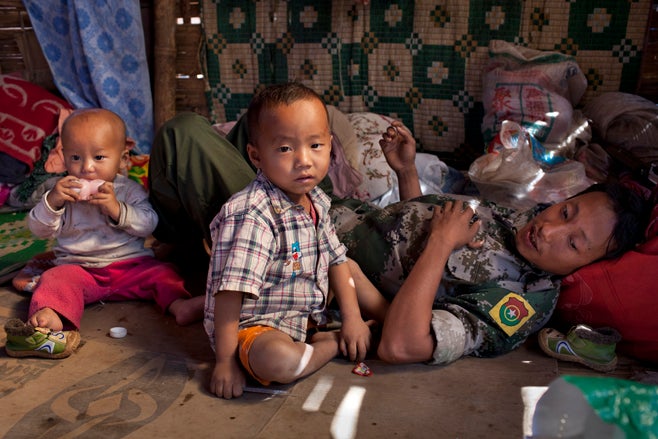
An ethnic Kachin child peers out of his shack at a refugee camp in Myitkyina in northern Burma. Fears are growing for the future of tens of thousands of refugees uprooted by ethnic conflict in northern Burma, despite the reformist government An ethnic Kachin child peers out of his shack at a refugee camp in Myitkyina in northern Burma. Fears are growing for the future of tens of thousands of refugees uprooted by ethnic conflict in northern Burma, despite the reformist government's talk of peace with the rebels. Civilians in camps in northernmost Kachin state lack adequate shelter, sanitation as well as food and water supplies, and with the monsoon looming the risk of malaria and other diseases is increasing, relief workers say. (AFP Photo)
Share This Page
9
7
0
0
Share with google+ :


Post a comment
Please login to post comment

Comments
Be the first to write your opinion!
Fears are growing for the future of tens of thousands of refugees uprooted by ethnic conflict in northern Burma, despite the reformist government’s talk of peace with the rebels.

Civilians in camps in northernmost Kachin state lack adequate shelter, sanitation as well as food and water supplies, and with the monsoon looming the risk of malaria and other diseases is increasing, relief workers say.

UN agencies are struggling to deliver aid to those most in need, particularly in rebel-held areas in the mountainous state bordering China, and access will become even harder when the rainy season starts in around May.

“The weather would have a huge impact on anybody that is displaced,” said Aye Win, a spokesman for the United Nations in Yangon, urging “a solution so that aid can be delivered as soon as possible”.

The campaign group Refugees International has warned of the risk of a “serious humanitarian crisis” in the region.

Many of the refugees are traumatized after fleeing clashes between government troops and guerrillas with the Kachin Independence Army (KIA), which controls swathes of the state.

The predominantly Baptist and Catholic Kachin account for about seven percent of Burma’s population and live in the remote far north near China.

The KIA used to be one of the most powerful armed rebel groups, but signed a ceasefire with the junta in 1994. Today their guerrilla army is thought to be at least several thousand strong.

The conflict re-erupted in June last year as anger grew over a clutch of Chinese-backed hydropower projects in the region.

Fighting has raged since then despite the new quasi-civilian government’s insistence that it wants to reach peace deals with the country’s various armed rebel groups.

“When the mines exploded near our home, it was like an earthquake. Our houses were shaken. We were really frightened,” Khun Mai, a 37-year-old ethnic Kachin woman, said while cradling her three-month-old baby at a camp housing hundreds of refugees in a church compound.

Having reached the state capital Myitkyina, which is relatively easy for relief workers to access, her family has a temporary bamboo hut to sleep in and food donations from local aid groups and the UN World Food Program.

She and her family fled their home near the town of Laiza, which is under the control of the KIA, in June last year and crossed into government-held territory.

Some of her relatives and friends, including children from her village, were killed by landmines or illness while escaping.

“My children think they have to run away forever,” Khun Mai said.

A new report by Human Rights Watch, due out on Tuesday, estimates that about 75,000 ethnic Kachin people have been displaced by the conflict.

It accuses the Burmese army of abuses such as the torture and rape of civilians, conscripted forced labor on the frontlines — including children as young as 14 — and blocking international relief efforts.

The report also accuses the Kachin rebels of using child soldiers and anti-personnel landmines, and the refugees fear that even a peace pact would not end the violence.

“I worry the situation could be worse if there is a ceasefire. The [government] soldiers do what they want in our region,” said Aung Mai, a 39-year-old bishop staying at a camp in the government-held town of Bahmo.

Civil war has gripped parts of Burma since independence in 1948. An end to the conflicts and alleged rights abuses involving government troops is a key demand of Western nations which have imposed sanctions on the regime.

While the government has signed peace deals with other insurgent groups, several rounds of talks with the political wing of the Kachin rebels have failed to bear fruit.

During a visit to Burma last week, US special envoy Derek Mitchell said the violence in Kachin was inconsistent with the government’s reformist bent.

“The immediate concern that we have is on the issue of internally displaced persons, who by any definition are innocents caught in the crossfire of conflict,” he said, urging the government to enable aid to reach the victims.

A group of prominent Kachin businessmen have volunteered to be negotiators between the KIA’s political wing and the government.

“The people are really in trouble,” one of the mediators, Yup Zaw Hkaung, told AFP.

He said about 20,000 refugees have fled their homes in government-controlled areas while roughly 50,000 have been uprooted in rebel-held territory.

“The fighting must stop if we are to save the traumatized people.”

Agence France-Presse
http://www.thejakartaglobe.com/international/conflict-hit-burma-refugees-yearn-for-peace/505853

Burma: Reforms Yet to Reach Kachin State

|0 comments
http://www.hrw.org/news/2012/03/20/burma-reforms-yet-reach-kachin-state
Army Abuses and Blocked Aid
March 20, 2012
The Burmese army is committing unchecked abuses in Kachin State while the government blocks humanitarian aid to those most in need. Both the army and Kachin rebels need to act to prevent a bad situation for civilians from getting even worse.
Elaine Pearson, deputy Asia director at Human Rights Watch
(Bangkok) – The Burmese government has committed serious abuses and blocked humanitarian aid to tens of thousands of displaced civilians since June 2011, in fighting in Burma’s northern Kachin State, Human Rights Watch said in a report released today. Some 75,000 ethnic Kachin displaced persons and refugees are in desperate need of food, medicine, and shelter, Human Rights Watch said.

The 83-page report, “‘Untold Miseries’: Wartime Abuses and Forced Displacement in Burma’s Kachin State,” describes how the Burmese army has attacked Kachin villages, razed homes, pillaged properties, and forced the displacement of tens of thousands of people. Soldiers have threatened and tortured civilians during interrogations and raped women. The army has also used antipersonnel mines and conscripted forced laborers, including children as young as 14, on the front lines.

“The Burmese army is committing unchecked abuses in Kachin State while the government blocks humanitarian aid to those most in need,” said Elaine Pearson, deputy Asia director at Human Rights Watch. “Both the army and Kachin rebels need to act to prevent a bad situation for civilians from getting even worse.”

Human Rights Watch travelled twice to areas in Kachin State in 2011, visiting nine camps for internally displaced persons and areas in China’s Yunnan province where refugees have fled, and has continued to monitor the situation. The report is based on more than 100 interviews with displaced persons, refugees, and victims of abuses, as well as Kachin rebels, Burmese army deserters, and relief workers.

The Burmese government and the Kachin Independence Army (KIA) need to take effective measures to end abuses by their forces, ensure humanitarian access, and permit an independent international mechanism to investigate abuses by all sides, Human Rights Watch said.

Renewed Burmese army operations against the Kachin Independence Army began in June in a contested area surrounding a Chinese-led hydropower dam, ending 17 years of ceasefire between the government and Kachin insurgents.

Displaced Kachin civilians described being forced to work on the front lines for the Burmese army, enduring torture, and being fired upon by soldiers. Burmese troops have deliberately and indiscriminately attacked Kachin civilians with small arms and mortars, Human Rights Watch found. Human Rights Watch also found evidence of rape by Burmese soldiers.

One man, forced to porter for the army for 19 days, told Human Rights Watch he witnessed the repeated rape of two Kachin women: “Soldiers would come and take the women and bring them from tent to tent. We were so afraid and we couldn’t watch the whole night. The next morning, the women couldn’t walk right. They seemed like they were in pain. They walked hunched over. And they were crying.”

The Kachin Independence Army has also been involved in serious abuses, including using child soldiers and antipersonnel mines, Human Rights Watch said. Both sides’ use of mines, which do not discriminate between combatants and civilians, will complicate the safe return of displaced civilians to their villages when hostilities cease.

Human Rights Watch called on the Burmese government to ask the UN Office of the High Commissioner for Human Rights to establish an office in Burma with a standard protection, promotion, and technical assistance mandate.

Burma’s newly created National Human Rights Commission has not played an effective role in monitoring abuses in Kachin State, Human Rights Watch said. In February 2012, the commission’s chairman, Win Mra, announced that the commission would not investigate allegations of abuses in the country’s ethnic armed conflict areas due to the government’s efforts to negotiate ceasefires.

“Concerned governments should urgently support an independent international mechanism to investigate abuses by all sides to the conflict in Kachin State and in other ethnic areas,” Pearson said. “An objective investigation into abuses in Burma’s ethnic areas won’t happen unless the UN is involved, and such an effort can help deter future abuses.”

Of the 75,000 Kachin civilians displaced since June, at least 45,000 have sought refuge in 30 camps for internally displaced persons in Kachin Independence Army-controlled territory along the Burma-China border. The Burmese government has only granted UN agencies access to this area once, in December. Even then, UN agencies were not able to visit several areas where tens of thousands of displaced persons reside. In areas it controls, the Kachin Independence Army and networks of local Kachin organizations have tried to meet growing humanitarian needs, but international support for civilian-relief organizations operating out of Kachin State has been sporadic and inadequate.

Humanitarian needs of displaced persons in Kachin State include food and other necessities, such as medicine, blankets, warm clothing, firewood and fuel, and adequate shelter.

The worsening situation in Kachin State contrasts starkly with hopeful human rights developments in lowland Burma in recent months, including the release of prominent political prisoners, a spate of legal reforms, and greater media freedom. In by-elections scheduled for April 1, the pro-democracy leader Aung San Suu Kyi will run for a seat in the national parliament.

“There’s still a long way to go before the people of Burma, particularly those in conflict areas, benefit from recent promises of reform,” Pearson said. “The international community should not become complacent about the serious human rights violations still plaguing Burma.”

Accounts from “Untold Miseries”

“While I was taking a shower, the Burmese army soldiers came and fired a machine gun. My children had to jump down from the hut in the farm, and I had to hide to not be shot.... The soldiers … were standing and shooting. If we didn’t flee, we’d have been shot dead, because the bullets hit the ceiling.”
– F.F., 35, female, Kachin State, Burma, November 16, 2011

“They [Burmese army soldiers] said that we villagers are KIA, and that the KIA are villagers, and that’s why they shot at us. The Burmese soldiers said for us not to cross a certain area or they’ll shoot us. ‘We’ll shoot everyone, young or old, man or women, we don’t care,’ they said. ‘If your grandparent is a KIA, we will kill the parents and grandchildren too,’ one soldier said. ‘We will kill three generations.’”
– A.E., 40, female, Yunnan Province, China, November 2011

“First they beat him, and then they put a bag over his head and tied it tight around his neck.... When his head was covered with plastic, they poured the water, and the plastic was close on his nose and mouth and he couldn’t breathe. Even though he couldn’t speak, they kept asking if he was a [KIA] soldier. They kept beating him severely.”
– Mae Nu, 40, who witnessed Burmese army soldiers torture an 18-year-old man, Kachin State, November 15, 2011

“[The Burmese army soldiers] tied my son and they made him walk in front of them. My daughter-in-law, my son, and I had to walk in front of them. After we walked for a while they tied my daughter-in-law, and me and my son too. They tied my left hand and connected it to my son’s right hand with a long string. We walked in a line with two soldiers on each side and four soldiers behind us. We carried three big bags of corn. We had about ten bags total.”
– Maru Maw, 70, forced to porter for the Burmese army and fired upon when he escaped, Kachin State, November 21, 2011

“We had to learn how to shoot, how to walk, how to live, how to behave and live in the jungle, and other things. It [basic training] was three months long. There were over 200 in the training. Most were older but I had some friends my age in the training.... I don’t have my own gun and cannot carry one because they think I am too young. I mostly prepare meals for officers and send letters back and forth.”
– Maru P., 16, child soldier in the KIA, Kachin State, November 14, 2011

Sunday, December 11, 2011

CHINA GOVERNMENT HAS ASK 2000 KACHIN IDP IN LA YING TO LEAVE CHINA IMMEDIATELY ON 09 DECEMBER 2011

|0 comments
ACCORDING TO EYES REPORT, GOVERNMENT OF CHINA FORCE 2000 KACHIN INTERNALLY DISPLACED PEOPLE(IDP) CROSS OVER TO LA YING CHINA. CHINA GOVERNMENT HAS ASK 2000 KACHIN IDP IN LA YING TO LEAVE CHINA IMMEDIATELY ON 09 DECEMBER 2011 INTEAD OF ASSISTING KCHIN PEOPLE IN NEED DUE TO FIERCE CIVIL WAR IN KACHIN LAND BURMA. CHINA IS SUPPORT BURMA FOR HIS OWN ECONOMIC INTEREST FROM KACHIN LAND BURMA. ACCORDING REPORT, CHINA ARMY BRUTALITY CIVIL WAR AGAINST KIA AND KACHIN PEOPLE IN BURMA REFUSAL TO WELCOME KACHIN IDP IN LA YANG, CHINA HAS INSERTING SUFFERING TO KACHIN IDP. THIS IS BECAUSE OF CHINA GOVERNMENT AND BURMA GOVERNMENT IS COORDINATING CIVIL WAR AGAINST KIA AND KACHIN PEOPLE IN KACHIN LAND, BURMA. CHINA STILL HAS MANY MAJOR INSVESTMENT IN BURMA ALTHOUGH BILLION DOLLAR DAM PROJECT MYITKYINA WAS SUSPENDED RECENTLY. WE KACHIN PEOPLE CALL UPON CHINA GOVERNMENT TO STOP SUPPORTING BURMA REGIME GOVERNMENT CRUEL CIVIL WAR IN AGAINST KACHIN PEOPLE WITH ECONOMICALLY OR ARMS SALES, PROVIDE INFORMATION TO BURMA ARMY AND EQUIPMENTS. WE KACHIN PEOPLE AROUND THE WORLD WILL RETALIATE WITH SERIOUS RESISTANCE TO CHINA GOVERNMENT. WE URGE CHINA GOVERNMENT TO TAKE CONSTRUCTIVE MEASURE TO DEFUSE CIVIL WAR SITUATION IN KACHIN STATE BURMA IF CHINA WISH TO CONTINUE ITS MAJOR INVESTMENT IN KACHIN LAND SUCH AS NATERAL GAS PROJECT, RAIL WAY PROJECT ACROSS KACHIN STATE, CHINA CROSS BORDER TRADE, JADE, GOLD AND OTHER PRECIOUS MINERAL MINING IN KACHIN STATE, TEAK WOOD AND TIMBER TRADING WITH KACHIN STATE, BURMA. WE KACHIN PEOPLE AND KIA SEEKING PEACEFUL MEAN TO RESOLVE THE CONFLICTS BETWEEN ALL ETHNIC ARMS GROUPS WITH 17 YEARS OF CEASE FIRE WITH BURMA GOVERNMENT. INSTEAD BURMA REGIME GOVERNMENT WAS LAUNCHING CIVIL WAR SINCE 09 JUNE 2011 AND STILL CONTINUE FIERCE KILLING AGAINST KACHIN CIVILIAN.

Thursday, December 8, 2011

IDP SITUATION FROM EASTERN KACHIN STATE

|0 comments

More Kachin Refugees Increase, Int'l NGOs Denied Access

The Burmese government continues to deny the UN and international aid organizations access to war refugees in conflict zones in Kachin State, northern Burma, where thousands of local villagers have been displaced by fierce fighting between government troops and Kachin rebels.

Local relief workers estimate that there are more than 34,000 war refugees in the town of Laiza, which hosts the headquarters of the rebel Kachin Independence Army (KIA), the militia that has engaged the Burmese army for the past six months.

At least 7,000 local civilians were displaced in the first week of December from 30 villages in the townships of Momauk, Waimaw and Bamaw, all of which are close to the Sino-Burmese border, as clashes intensify between the two sides, according to local aid groups(More++click+++)

Kachin IDPs AND REFUGEES UPDATE SITUATION ON NOV AND DEC 2011

|0 comments

Monday, November 28, 2011

Thousands of Kachin Villagers Displaced in Kachin State

|0 comments